
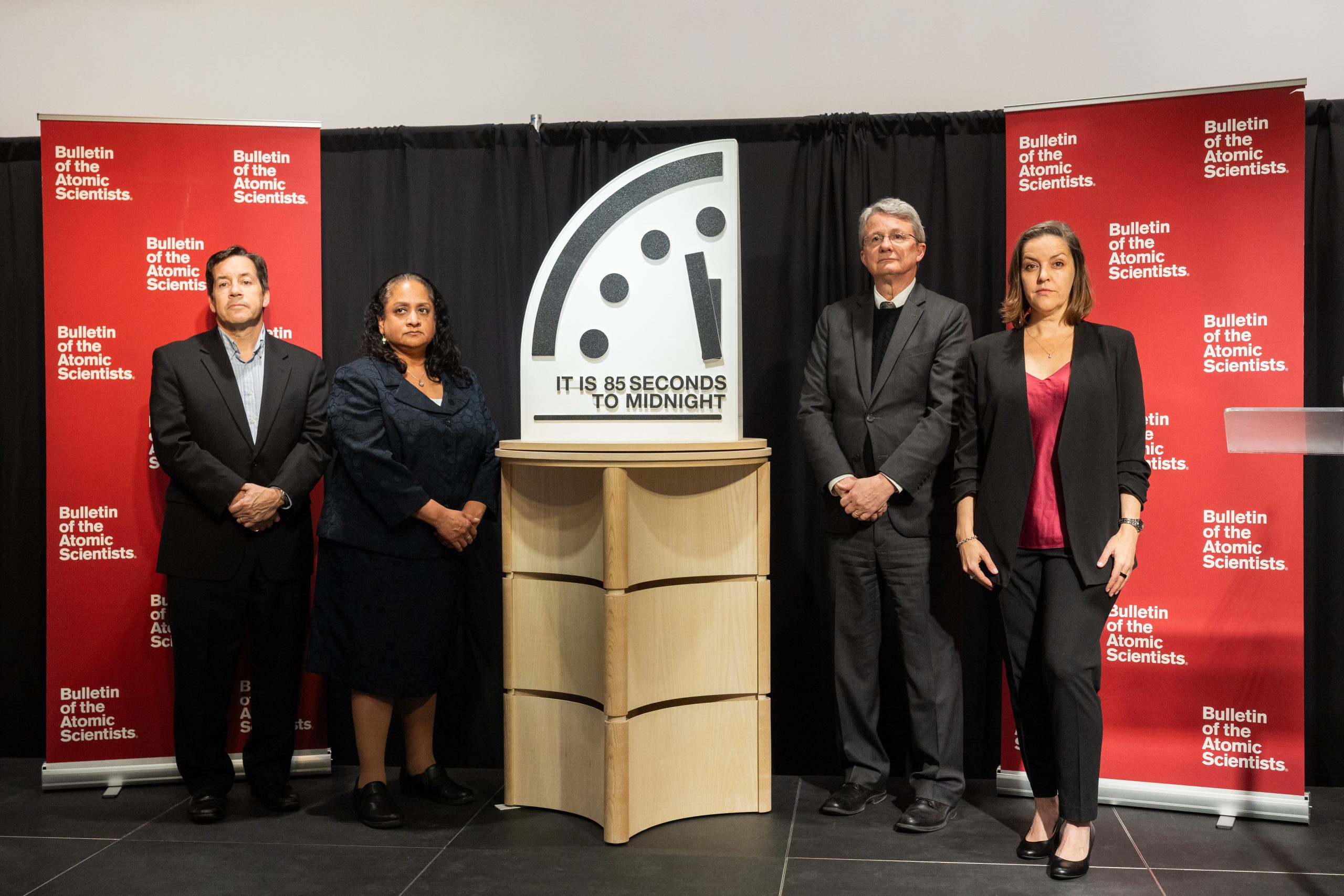
 Bulletin of Atomic Scientists. Credit: Jamie Christiaini
Today, the Bulletin of the Atomic Scientists has moved its “Doomsday Clock” to the closest to midnight it has ever been. Due to the increased likelihood that humanity will suffer a global catastrophe, we are now just “85 seconds to midnight,” 4 seconds closer to midnight than we were last year.
The clock is not just a number – it’s a warning about the direction in which our world is heading; a visual metaphor designed to warn the public about how close we are to destroying our world with dangerous technologies of our own innovation. The clock highlights how close humanity is to self-destruction as a result of dangerous technologies, particularly nuclear weapons, while underscoring the urgent need for arms control and risk reduction. Tri-Valley CAREs pays particular attention to the clock every year because nuclear weapons remain the most immediate and destructive threat.
The Bulletin created the Doomsday Clock in 1947, when the main threat to humanity was considered to be nuclear weapons, particularly the prospect of a nuclear arms race between the United States and the Soviet Union. In those years, the risk of nuclear destruction was ever present. The clock illustrates that the danger of nuclear war has not disappeared, and worsened in the last year.
Over time, the Bulletin has expanded the range of factors considered when setting the clock. In 2007, the threat of climate change was included in the calculations for the first time. This change acknowledged that environmental destruction and uncontrolled technological development both pose existential threats to the survival of humanity.
In recent years, biological risks were added to these threats, as well as the destabilizing influence of new technologies, including artificial intelligence and its increasingly active use in the military area.
The Bulletin’s Science and Security Board, which includes leading scientists and experts in nuclear technology, climate science, and global security, maintains responsibility for setting the time on the Doomsday Clock. The Board meets twice a year to analyze world events, consult with specialists from various disciplines, and determine whether humanity has moved closer to or further away from catastrophe.
In its work, the Board also takes into account the opinion of the Bulletin’s Board of Sponsors, which includes several Nobel laureates. The setting of the Doomsday Clock in 2026 reflects a world characterized by growing geopolitical instability, the breakdown of arms control agreements, and renewed large-scale investment in nuclear weapons. Alexandra Bell, president and CEO, Bulletin of the Atomic Scientists, said: “The Doomsday Clock’s message cannot be clearer. Catastrophic risks are on the rise, cooperation is on the decline, and we are running out of time. Change is both necessary and possible, but the global community must demand swift action from their leaders.”
Ongoing armed conflicts, rising tensions between nuclear powers, and the increasing use of advanced technologies in the military sphere create conditions in which the risk of error, miscalculation, or escalation becomes dangerously high. Daniel Holz, Security Board chair, Bulletin of Atomic Scientists, outlined a list of reasons why the hands were moved 4 seconds closer to midnight: “The dangerous trends in nuclear risk, climate change, disruptive technologies like AI, and biosecurity are accompanied by another frightening development: the rise of nationalistic autocracies in countries around the world.”
As the hands of the Doomsday Clock approach midnight, there are signs that the world may be returning to policies that many believed had been left behind after the end of the Cold War. In a recent statement on Truth social media, President Donald Trump announced that he had asked the Pentagon to begin testing US nuclear weapons, citing the actions of Russia and China.
The last US underground test, “Divider,” was conducted on September 23, 1992. This test marked the end of the nuclear testing era – and the beginning of a long moratorium, which to many symbolized humanity’s attempt to step back from a dangerous precipice. Trumps’s statement was published shortly before a planned meeting with Chinese President Xi Jinping and contained very few specific details about what exactly such tests might entail.
As we explain in our October 31, 2025 blog, “Trump’s Vague Call for New Nuclear Testing, Livermore Lab’s Potential Role, and the Burgeoning Opposition,” there is little support for resuming explosive nuclear weapons testing even within the U.S. nuclear weapons establishment itself. Our analysis highlights a critical but often overlooked reality: no military or technical justification for explosive nuclear testing at this time. Lawrence Livermore and Los Alamos National Laboratories are able to fully certify the safety, reliability and security of the US stockpile every year using their existing diagnostic tools without any need for explosive nuclear testing.
Trump’s statement itself signals a shift in US nuclear policy and raises serious concerns from the perspective of global security. Even if explosive nuclear tests do not follow, the statement itself could prompt other countries to test their nuclear weapons.
Against this backdrop, the consequences of such statements extend beyond specific political decisions. When the resumption of nuclear testing is presented as acceptable, it intensifies the atmosphere of anxiety and distrust in the world. In the context of growing tension and uncertainty, the warning of the Doomsday Clock takes on particular significance.
Tri-Valley CAREs will continue to monitor events related to the Doomsday Clock and will keep the community informed about what actions can be taken to reduce the nuclear threat and move the clock away from midnight.
Read the full statement from the Bulletin of Atomic Scientists here