
Huge Increase for “Modernizing” Nuclear Weapons Production; Science Budget Slashed
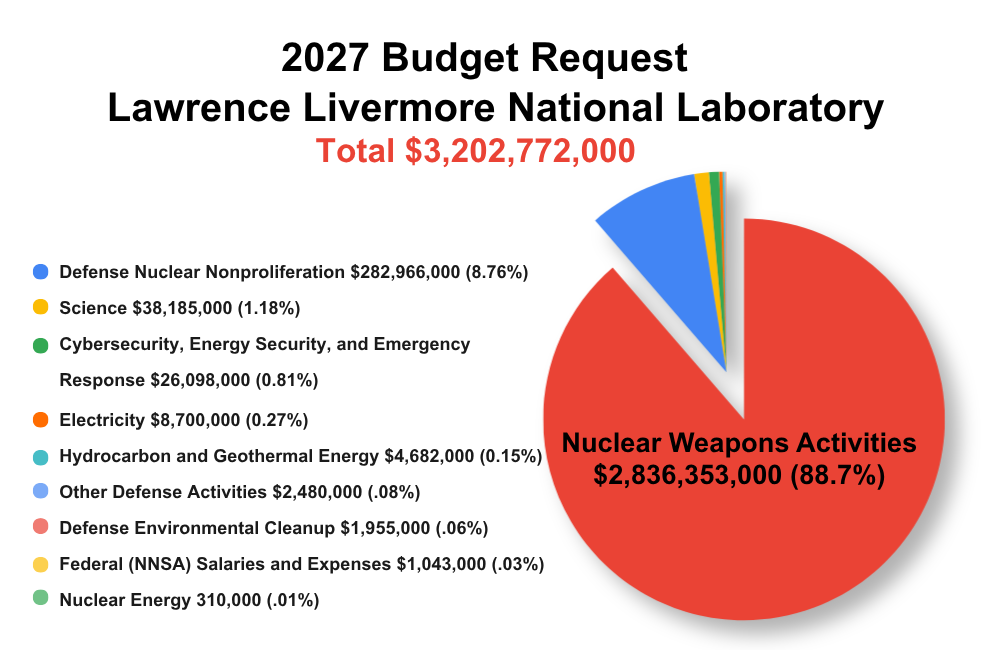
The administration’s Fiscal Year (FY) 2027 budget request for Lawrence Livermore National Laboratory has been released, and it is staggering. The one-year funding request for $3,202,772,000 is the highest ever for LLNL. It is 9.2% higher than last year’s request, and amounts to a 28% increase during the first two years of Trump’s second term. LLNL is cashing in with Trump!
After last year’s elimination of LLNL’s Energy Efficiency and Renewables program, this year’s budget eliminates “Critical Minerals and Energy Innovation” programs and contains a large reduction (-32%) in the “Science” budget compared to what was enacted over the last two years, with the “Biological and Environmental Research” portion of the science budget down 80%.
LLNL announced in 2025 its proposal to “Enhance Plutonium Utilization,” showing its intent to increase the centrality of nuclear weapons activities to its mission, and repositioning itself as a full-service nuclear weapons laboratory, despite any potential security concerns. Civilian science that could help or solve some of the world’s problems, like preventing climate change, biodiversity collapse, renewable energy technologies and contaminant remediation are no longer pursuits of this national lab. Those areas are not given any priority. It’s nuclear weapons all day long, and bagloads of money for them.
With nearly 90% of the Lab’s budget going for nuclear weapons activities ($2,836,353,000, which is up 8% over last year’s request), the lab is positioning itself both as the primary new nuclear warhead research and design laboratory and as the production coordinator of those warheads.
With 3 new nuclear weapons (W87-1, W80-5 and W93) and one “Life Extension Program” (W80-4) all in various stages of development at the Lab in FY2027, this budget request highlights the extent of LLNL’s commitment to nuclear weapons forever. New this year is an additional $8 million under “Stockpile modernization” for “Future Programs.”
Whether it is plutonium pits, uranium secondaries, high explosives, or tritium and other “defense fuels,” the Lab’s nuclear weapons “production modernization” budget has grown 106% in the last two years! For example, LLNL is the lead design lab for the W87-1 warhead that will sit atop the new Sentinel Intercontinental Ballistic Missile. The W87-1 will need all new plutonium pits, which will take up at least the first 10 years of plutonium pit production at Los Alamos National Laboratory.
LLNL’s “Enterprise Plutonium Pit Production Support” work will more than double in FY2027 to $166,696,000. As mentioned, this work is the primary driver for its proposed “Enhanced Plutonium Utilization.” This work is connected to the plutonium pit production plans at both Los Alamos Lab and the Savannah River Site in South Carolina. It is also connected to the component production at Kansas City Plant in Missouri, the assembly work at Pantex Plant, and the sub-critical testing of the new warheads at Nevada National Security Site.
Tri-Valley CAREs, Nuclear Watch New Mexico and Savannah River Site Watch were plaintiffs in litigation against the National Nuclear Security Administration for their failure to analyze the impacts of this nationwide plan under the National Environmental Policy Act. The Judge ruled in our favor and required NNSA to prepare a full Programmatic Environmental Impact Statement on Plutonium Pit Production, which is due to be released in draft in May 2026. There will be a public hearing in Livermore and 4 other locations, as well as a 90-day written public comment period. This may be our last opportunity to speak out in opposition to the agency decision makers about this massive nuclear weapons build up and its massive costs. (Note: Tri-Valley CAREs will send information on how you can participate in the coming weeks.)
Finally, despite these massive increases in nuclear weapons activities funding, the amount requested for the cleanup at LLNL remains stubbornly flat, at just $1,955,000 (.06% of the FY2027 budget request). The lack of prioritization of the directly affected community surrounding the site is reflected in the lack of budgetary prioritization of the cleanup, which currently has an infinite timeline until completion.
Tri-Valley CAREs members have been raising the alarm in Washington, DC and locally about these concerns. Our work in the coming months and years will seek to change what gets funded at LLNL, and in doing so, achieve a safer, healthier future for our community. Join us!
Para leer esta información en español HAGA CLIC AQUÍ!