
Tri-Valley CAREs has a long history of using the Freedom of Information Act (FOIA), 5 U.S.C. § 552, which enables United States citizens to request access to fully or partially unreleased or uncirculated information and documents in control of the U.S. government, to obtain information regarding activities and operations at Lawrence Livermore National Laboratory (LLNL) and sometimes at other nuclear weapons sites, that is not made readily available to the public.
Currently, Tri-Valley CAREs has 22 FOIA requests for which we are awaiting response. They seek information and data on a wide range of topics relevant to nuclear weapons production and nuclear waste and other activities at LLNL.
On August 13, 2025, Tri-Valley CAREs submitted a FOIA request to the National Nuclear Security Administration (NNSA) requesting the following information:
“Any and all documents from January 1, 2023 until the date of the search, including but not limited to, reports, records, and data sets relating to air monitoring for Lawrence Livermore Laboratory Main Site in Livermore, CA.”
Under FOIA law, a federal office must determine whether to comply with a request within twenty business days from the date of receipt of such a request. However, it took over one year for this FOIA request to be fulfilled, despite multiple attempts at correspondence and multiple notices of statutory violation. The Final Response Letter consisted of 60 responsive documents, totaling 1033 pages. A majority of the provided documents were air emissions data and charts that are relatively difficult to decipher. 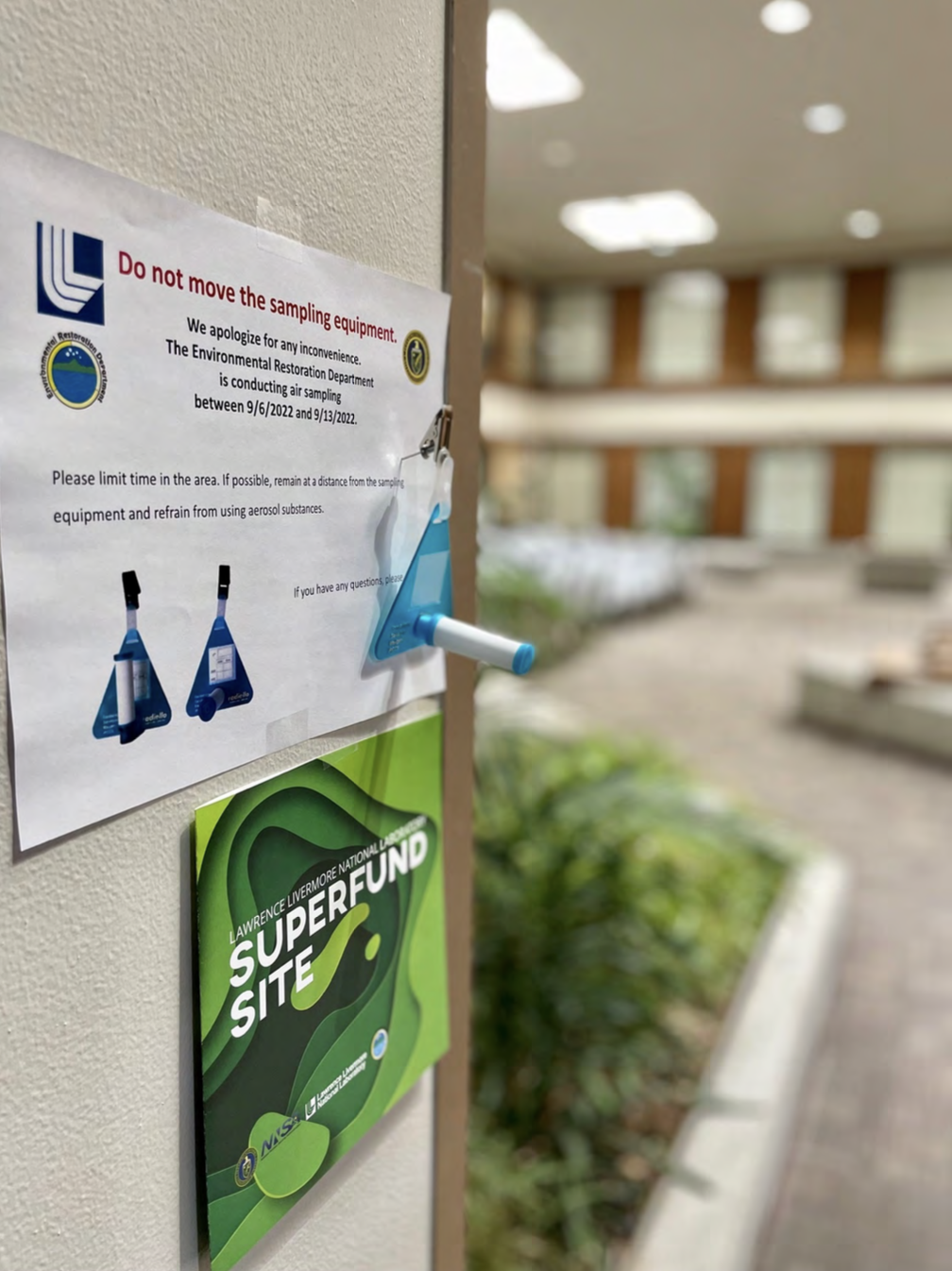
Upon review of this length response, four primary issues stood out that include information on releases of radioactive tritium gas into the air, chemical indoor air contamination in a lab facility, potentially risky demolition activities that may have released contamination into the air and mysterious data losses.
- Document 22 – Algorithm Error & Unplanned Release of Tritium
Document 22 of the Final Response Letter was the LLNL National Emission Standards for Hazardous Air Pollutants (NESHAPs) 2024 Annual Report, published in June of 2025. This document addresses LLNL’s airborne radionuclide emissions for 2024, and evaluates the resulting radiation doses to the public to demonstrate compliance with the Environmental Protection Agency’s (EPA) NESHAPs. The document further describes emission sources, monitoring methods, dose modeling, and notable events that occurred within the target year.
In this annual report, LLNL acknowledged that,
“The Calendar Year 2023 (CY2023) tritium estimate for diffuse and non-monitored source dose was found to have an error in the optimization algorithm resulting in an over estimation of tritium. This [error] occurred during transition from the previous R-code script conversion to Python script. The revised total dose is 2.3E-3 mrem, previously reported was 2.5E-3 mrem. The revised diffuse and non-monitored dose is 1.9E-4 mrem, previously reported was 4.0E-4 mrem.”
Although it is seemingly positive that the actual doses of tritium were less than initially reported, Tri-Valley CAREs remains concerned regarding this error. With issues in reporting algorithms, it would appear that estimations could just as easily be lower than reported as they could be higher than reported. This could mean higher exposure to nuclear materials and waste for both defense nuclear facility employees and surrounding communities, without accurate knowledge and awareness regarding such heightened exposures.
Additionally, in the 2024 Annual Report, Section 5.1 describes notable unplanned releases. The report states that,
“On October 10, 2024, a valve misalignment occurred at Building 298 (B298) resulting in 35.6 Ci of tritium released through the room ventilation exhaust stack.”
The report further suggests that under 40 CFR 302, the U.S. EPA’s Reportable Quantities (RQ) for tritium is 100 Ci or greater, meaning that the October 10 unplanned release was 35.6% of the RQ. A reportable quantity is a set amount of a given hazardous substance that, if released within a 24 hour period, must be reported to federal authorities. Since the B298 unplanned release was less than the EPA’s RQ for tritium, LNLL was not required to report the release to federal authorities.
LLNL noted that a thorough review of the incident was conducted and that numerous “administrative and engineered controls” were implemented so as to prevent or reduce reoccurrence of such an unplanned release. Amongst these controls included (1) a two-person rule extended to “physical verification” of valve position; (2) locks placed on critical valves to force operators to be deliberate about changing their state; (3) interlocks installed on solenoid valves to prevent open access to vent during tritium gas-ops; (4) installing a collection vessel before the vent to serve as a hold-point for exhaust gases; (5) increasing meeting frequency on conduct of operations and risk discussion; and (6) updated procedures and internal documents to reflect these changes.”
While the review of the unplanned release and the newly implemented controls that came as a result are promising, an unplanned release of radioactive material into the air is cause for concern in any case. Tri-Valley CAREs will continue to monitor and spread awareness regarding any known unplanned releases, in an effort to keep the public and LLNL employees aware of potential increased exposures.
- Documents 55 & 56 – Exceedances of PCE in Building 511
In Document 55 of the Final Response Letter, an email thread between various NNSA, LLNL, EPA, and California Department of Toxic Substances Control (DTSC), and other employees is provided. The subject of conversation is the Building 511 Air Sample Results Report, provided via Document 56 of the Final Response Letter. While names of employees are redacted, the initial email was sent from an individual at the NNSA to individuals at each of the aforementioned agencies and departments. This initial message suggests that, with regards to the July 11, 2023 through July 18, 2023 air sampling event at Building 511 on the main Livermore Site,
“There were indoor air screening level exceedances of tetrachloroethene [PCE] in Room 158 [of Building 511] and chloroform in Room 144A.” The email additionally suggested that, “The exceedances are likely due to potential Volatile Organic Compound (VOC) sources located in the building.”
In response to this message and the report that was attached, a separate email in the thread referenced DTSC Geological Services Unit (GSU)’s comments on the report. The DTSC GSU commented that,
“The first sentence of the last paragraph [of the attached report] states: ‘DOE/LLNL believes that vapor intrusion (VI) from subsurface contamination to indoor air does not pose an indoor air inhalation risk to occupants in Building 511.’ The GSU does not disagree with this statement but believes it should be qualified by stating: ‘VI from subsurface contamination to indoor air does not pose an indoor air inhalation risk to occupants in Building 511 while the soil vapor treatment facilities around Building 511 are operating.”
This qualification is important in that it suggests that while the soil vapor treatment facilities around Building 511 are not operating, DTCS GSU is seemingly not as confident that there is no indoor inhalation risk to occupants in Building 511.
- Documents 59 & 60 – Potential Contaminant Release During Demolition of Building 251 (B251)
Document 59 of the Final Response Letter contains an email thread regarding hazard mitigation efforts at Building 251 on the main Livermore site, while Document 60 provides an interdepartmental letter regarding the commencement of demolition of Building 251. In the email thread, a conversation between DOE, NNSA, and LLNL employees begins on June 12, 2024 with the Deputy Principal Associate Director for Operations of Physical and Life Sciences (PLS) at LLNL stating that,
“My understanding is that there are ventilation components left in B251 that could be removed at modest cost while there are other components [that] would be more costly to remove. If there is room for compromise, I would focus on removing as much exhaust ventilation as cost and schedule can support.”
After much back and forth, in a separate, June 14, 2024 message later in the thread, a different LLNL employee suggests that,
“There are still concerns with ducting remaining in the building during demolition, and the preferred mitigation is removal prior to demolition of the structure.”
Then, in the Interdepartmental Letter circulated on July 1, 2024, with the subject, “B251 D&D Project Demolition Commencement,” it is noted that,
“[…] all relevant building hazards and related wastes have been removed from B251, with some exceptions. The exceptions include remaining ductwork and a shielding wall in [Room 1165]. After discussions with DOE, it was determined that the remaining ductwork will stay within the facility during demolition…”
In a March 18, 2025 blog posted by the Department of Energy, it is noted that Building 251 was successfully demolished in late 2024 “after crews successfully removed hazards from [the] historic facility. The blog additionally mentions that, “Abatement and hazard removal, vent duct removal and decontamination preceded the teardown.” Based on the conflicting information provided in the Interdepartmental Letter and the DOE Blog Post, it is unclear whether or not all of the ductwork was in fact removed prior to demolition of Building 251.
- Document 23 – Unexplained Loss of Data
Document 23 of the Final Response Letter was the LLNL National Emission Standards for Hazardous Air Pollutants (NESHAPs) 2023 Annual Report, published in June of 2024. This document served the same purpose as Document 22 mentioned above, though for the year prior.
In Section 2.1 of this report, in describing measured emissions of major sources, LLNL noted conservative stack release estimates over the sample interval of November 13, 2023 through December 31, 2023 for uranium-234, uranium-235, and uranium-238. The lab stated that,
“The reason estimated values are provided [for uranium-234, uranium-235, and uranium-238] is based on a loss of data resulting from some process failures and human performance issues.”
LLNL then stated that it had “documented the matter in the Laboratory’s Issues Tracking System with corrective actions to minimize or prevent data loss in the future.” Unfortunately, there was no specific indication of what process failures or human performance issues occurred, nor is there any concrete information regarding the alleged “corrective actions” implemented so as to prevent a similar failure from occurring in the future. When dealing with toxic, radioactive materials that have the potential to cause significant harm, Tri-Valley CAREs does not believe that estimations in the face of lost data are sufficient to satisfy the level of awareness owed to LLNL employees and the surrounding Livermore community. Further, Tri-Valley CAREs does not believe that a mere mention of undisclosed corrective actions is sufficient to rectify this failure.
In Conclusion
The Final Response to this FOIA raised a variety of concerns for Tri-Valley CAREs regarding air emissions at LLNL and we will continue to pursue information on these matters, and will provide updates as more information comes to light. Note that the response was only through 2025 and we will continue to seek environmental impact related information from the Lab via FOIA. Stay tuned!
|
Quote |
Location |
|
“The Calendar Year 2023 (CY2023) tritium estimate for diffuse and non-monitored source dose was found to have an error in the optimization algorithm resulting in an over estimation of tritium. This [error] occurred during transition from the previous R-code script conversion to Python script. The revised total dose is 2.3E-3 mrem, previously reported was 2.5E-3 mrem. The revised diffuse and non-monitored dose is 1.9E-4 mrem, previously reported was 4.0E-4 mrem.” |
Footnote “e” to Table 7 |
|
“On October 10, 2024, a valve misalignment occurred at Building 298 (B298) resulting in 35.6 Ci of tritium released through the room ventilation exhaust stack.” |
Section 5.1, Unplanned Releases |
|
“The reason estimated values are provided [for uranium-234, uranium-235, and uranium-238] is based on a loss of data resulting from some process failures and human performance issues.” |
Section 2.1, Major Sources: Measured Emissions |
|
“There were indoor air screening level exceedances of tetrachloroethene [PCE] in Room 158 [of Building 511] and chloroform in Room 144A.” The email additionally suggested that, “The exceedances are likely due to potential Volatile Organic Compound (VOC) sources located in the building.” |
First email of thread (October 5, 2023) |
|
“The first sentence of the last paragraph [of the attached report] states: ‘DOE/LLNL believes that vapor intrusion (VI) from subsurface contamination to indoor air does not pose an indoor air inhalation risk to occupants in Building 511.’ The GSU does not disagree with this statement but believes it should be qualified by stating: ‘VI from subsurface contamination to indoor air does not pose an indoor air inhalation risk to occupants in Building 511 while the soil vapor treatment facilities around Building 511 are operating.” |
Final email of thread (May 28, 2024) |
|
*Not quoted but referenced in connection to Document 55* |
|
|
“My understanding is that there are ventilation components left in B251 that could be removed at modest cost while there are other components [that] would be more costly to remove. If there is room for compromise, I would focus on removing as much exhaust ventilation as cost and schedule can support.” |
First email of thread (June 12, 2024) |
|
“There are still concerns with ducting remaining in the building during demolition, and the preferred mitigation is removal prior to demolition of the structure.” |
10th email of thread (June 14, 2024 at 8:50 AM) |
|
“[…] all relevant building hazards and related wastes have been removed from B251, with some exceptions. The exceptions include remaining ductwork and a shielding wall in [Room 1165]. After discussions with DOE, it was determined that the remaining ductwork will stay within the facility during demolition…” |
2nd – 3rd paragraphs |