
Lawrence Livermore National Laboratory’s 1104-page Site 2025 Annual Groundwater Report documents a large and technically complex groundwater cleanup. But containment is not cleanup, and the report does not answer the question most important to the public: When will the groundwater actually be clean?
More than three decades after groundwater treatment began, LLNL provides no estimate of how much contamination remains, no plume-by-plume completion schedule, and no enforceable cleanup date. Instead, the report repeatedly describes plumes as “stable,” “unchanged,” or “contained.” These words do not establish that restoration is approaching.
Less contamination removed in 2025
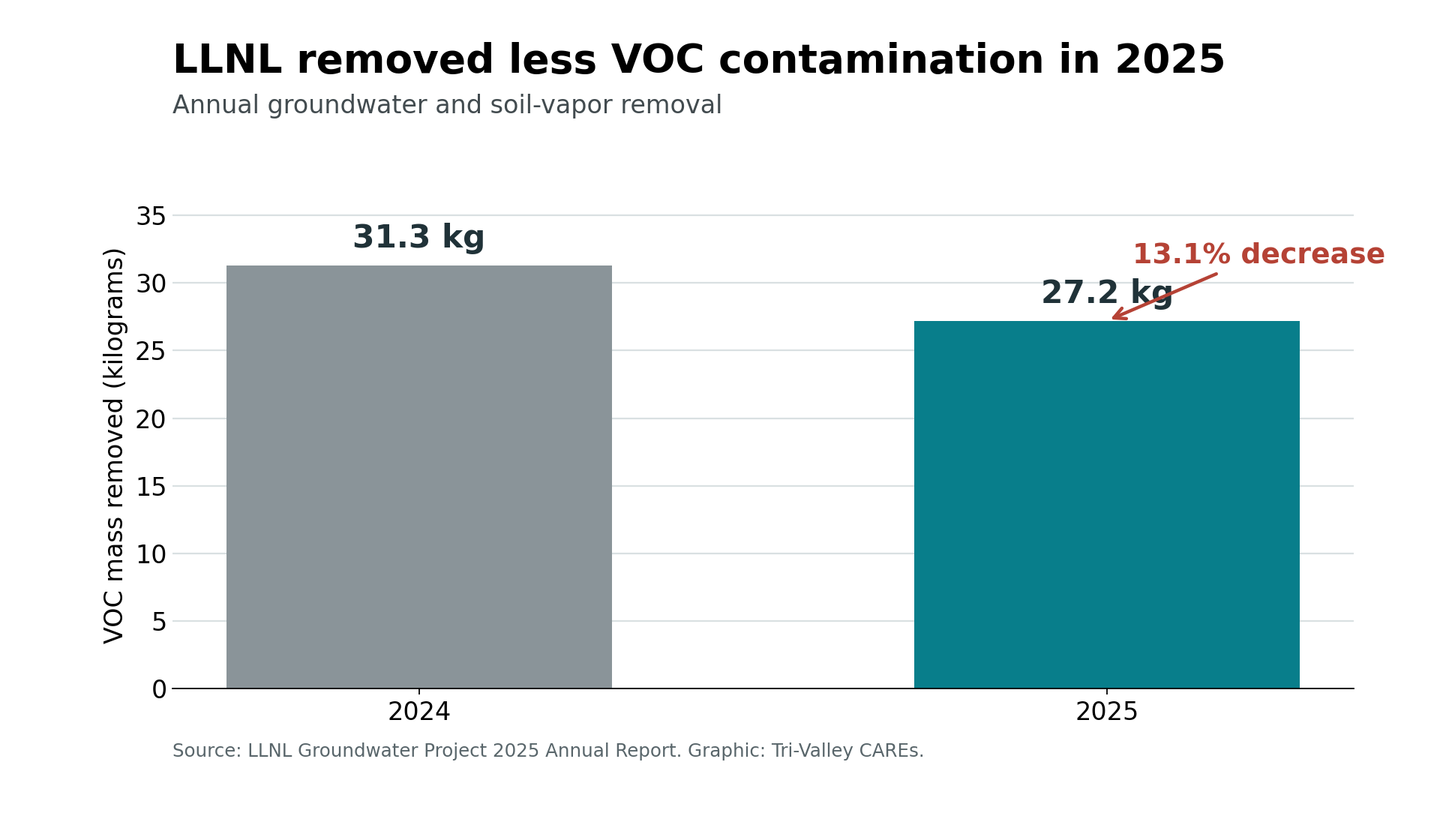
LLNL removed 27.2 kilograms of volatile organic compounds, or VOCs, in 2025. That was 13.1 percent less than the 31.3 kilograms removed in 2024.
A declining removal rate could mean that the treatment systems are reaching their limits, contaminants are trapped in less-accessible soil and groundwater, or outages are reducing performance. LLNL does not provide enough information to distinguish among these possibilities.
The laboratory emphasizes that it has removed 3,598 kilograms of VOCs since 1989. But that number lacks a crucial denominator. Has LLNL removed 90 percent of the original contamination, or 9 percent? Without an estimate of the mass remaining, the cumulative removal figure cannot tell the public how close the site is to cleanup.
High concentrations remain
The underlying groundwater data show that major source areas remain highly contaminated. A TCE result at well W-1250 reached 2,900 micrograms per liter in January 2025, 580 times the 5 µg/L cleanup standard. PCE reached 260 µg/L at W-116.
Vinyl chloride reached 58 µg/L at W-1652. California’s drinking-water standard for vinyl chloride is 0.5 µg/L, making this monitoring-well result 116 times the benchmark. The report also records rising TCE concentrations in several wells. W-1804-2 increased from 5.3 to 68 µg/L, W-1225 increased from 230 to 300 µg/L, and W-1253 increased from 710 to 1,160 µg/L. LLNL offers explanations for some individual changes, but the public needs a systematic analysis of rebound and worsening trends.
Budget problems and treatment outages
LLNL acknowledges that a year-long DOE/LLNL budget shortfall limited drilling and treatment-system improvements. Only one CERCLA drilling campaign proceeded in 2025, after additional funding was obtained.
Nineteen treatment facilities were shut down on November 6 during the federal government shutdown and generally restarted between November 17 and 19. Other outages lasted much longer. TFE-NW was offline for approximately 145 days after a pump failure. Off-site extraction well W-404 remained shut throughout 2025 because of unexplained silt. TF518-N did not operate at all because of mixed-waste problems connected to an issue documented as far back as 2009.
LLNL should publish evidence showing whether hydraulic capture was maintained during every major outage, and not simply report annual treatment totals.
The report also claims that water level controls prevent aquifer overdraft, while stating elsewhere that groundwater extraction from HSU-5 exceeded sustainable yield and caused water levels to fall by an average of four feet. These statements need to be reconciled.
Newly documented contamination near T5475
The only CERCLA drilling campaign conducted in 2025 investigated the source area near Treatment Facility 5475. LLNL drilled at 32 locations, including 24 west of the 2023 investigation area. The drilling found VOC contamination as high as 1,437 µg/L, mostly 90 to 140 feet underground. LLNL delayed its detailed explanation of the results until a 2026 meeting.
We don’t know if the contamination extends farther west than LLNL previously believed? If so, LLNL must explain whether its current cleanup systems and contamination maps are still adequate.
Tritium and hexavalent chromium
Four wells exceeded the 20,000 pCi/L tritium drinking-water standard during 2025. W-3004 measured 40,100 pCi/L in January and 31,500 pCi/L in December. Other wells have exceeded the standard repeatedly over several years. LLNL says tritium levels are falling mainly because the contamination is naturally becoming less radioactive over time. If waiting for radioactive decay is the cleanup strategy, LLNL should explain how long this will take and when more active cleanup would be required.
The report also gives little attention to hexavalent chromium. Well W-487 contained 7.6 times California’s drinking water standard. LLNL and regulators should explain whether the state’s newer standard requires additional cleanup.
Pilot projects show unresolved problems
LLNL points to experimental cleanup projects as signs of progress, but its own data show major problems.
At the TFD-HPD treatment area, TCE decreased in some places but rose sharply in well W-1652, from below 0.5 µg/L in October 2024 to 24 µg/L a year later. Vinyl chloride, a dangerous breakdown product, reached 58 µg/L. LLNL claims the contamination is likely breaking down, but it did not regularly find the expected final product or the necessary bacteria.
At the Eastern Landing Mat, important wells were not operating, air injection and heating had been shut down since 2021, and two repair attempts failed. LLNL should set a firm deadline to repair, replace, redesign or end the system.
At the TFC Hotspot, the iron treatment installed in 2014 now appears worn down and coated. TCE in well W-1212 rose from 14 µg/L in April 2024 to 91 µg/L in October 2025. LLNL should explain whether the treatment still works and when it will be replaced if it does not.
Vapor-intrusion contradiction
LLNL sampled indoor air in twelve buildings during winter 2025. TCE or PCE was detected in six, although no individual result exceeded the report’s target level.
The report does not consider the combined cancer risk from several chemicals found in the same buildings. Its testing method also produced no usable result for vinyl chloride, even though vinyl chloride is a major concern in the nearby TFD-HPD area.
LLNL says no soil-vapor cleanup system was shut down for more than 30 days, so it did not need additional indoor-air testing. However, the report also says the VTFD-HPD system did not operate at all in 2025 and that its extraction wells have been closed since 2010. LLNL must explain these conflicting statements and say whether it tested nearby occupied buildings.
Data-quality review was incomplete
Perhaps the most serious problem appears in Appendix G. LLNL states that:
- Complete 2025 test results were not available until March 2026.
- The data review was unfinished.
- Eleven results had already been rejected.
- More results might later be questioned or rejected.
- The final decision about the reliability of the data was still pending.
Despite this, the Executive Summary does not clearly warn readers that its conclusions are preliminary.
Appendix G also describes equipment problems, delayed results, 36 audit findings, inconsistent laboratory results and failed quality control tests. LLNL should publish a final update listing all rejected results and explaining whether any cleanup conclusions changed.
The report’s claim that sampling was 99 percent complete is misleading because it excludes wells that could not be sampled. LLNL collected 1,439 samples but missed 140 scheduled samples, meaning it actually completed about 91 percent of the planned sampling.
LLNL should report both percentages and list the wells that were missed, along with any gaps this created in monitoring the contamination.
Questions that need answers
TVC is asking LLNL, DOE, EPA and the Regional Water Board to answer the following questions:
- When will each contaminated area be cleaned up, and are those deadlines legally enforceable?
- How large was the 2025 budget shortfall, and what cleanup work was delayed?
- What is the long-term plan and timeline for cleaning up the tritium plume?
- Does California’s newer hexavalent-chromium standard require additional cleanup?
- Why does LLNL say TCE is likely breaking down completely when dangerous vinyl chloride is building up?
- Why does the report say no vapor-treatment system was shut down for more than 30 days when VTFD-HPD reportedly did not operate at all in 2025?
- Were PFAS and other emerging contaminants tested through another program?
- When will LLNL publish an easy-to-understand report, downloadable data and maps showing nearby homes, schools, workplaces and drinking-water sources?
When will we start showing real cleanup progress?
LLNL operates a large treatment system and has made some progress in containing contamination. But reporting how much water was treated, how many kilograms of pollution were removed or how many plumes remained “stable” does not answer the most important question: When will the contamination actually be cleaned up?
Before the next annual report, DOE and LLNL should publish a public dashboard for every plume and source area showing current concentrations, trends, estimated contaminant mass remaining, missed samples, data-quality limitations, the next enforceable milestone and the projected cleanup date.
LLNL’s claims should be supported by complete data. Every plume described as “stable” should have a clear and dated path to cleanup. Livermore residents should not have to search through a 1,104-page report to find out whether groundwater beneath and beyond a nuclear weapons laboratory is actually becoming cleaner.
Primary source: Lawrence Livermore National Laboratory, Site 2025 Annual Report, March 2026. Read the report