
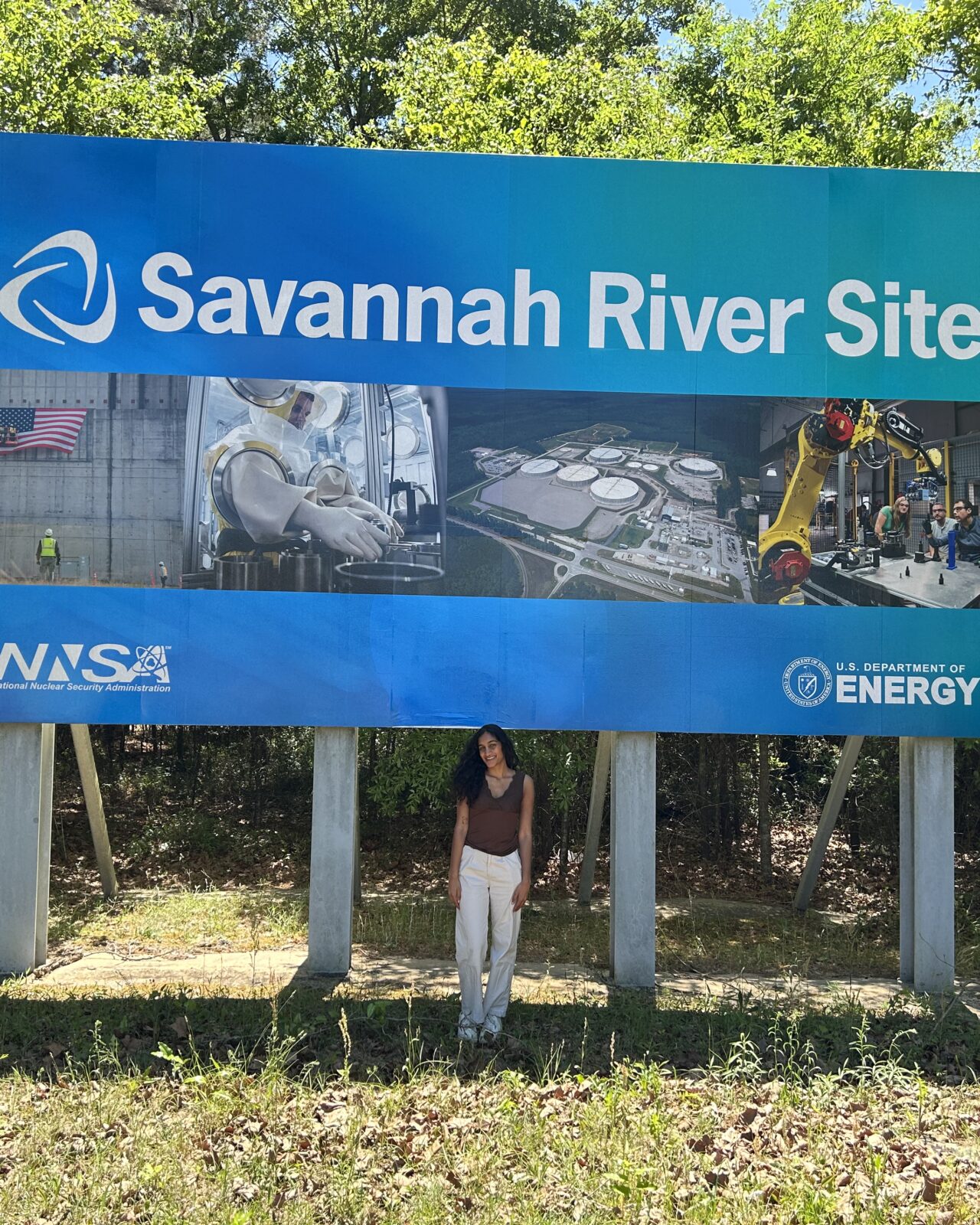
On April 21, Tri-Valley CAREs’ Nuclear Policy Program Director, Tanvi Kardile, accompanied by other plaintiffs Savannah River Site Watch and Nuclear Watch New Mexico, toured the plutonium “pit” bomb core production plant at the National Nuclear Security Administration’s (NNSA’s) Savannah River Site (SRS) near Aiken, South Carolina. We were accompanied by our attorney from the South Carolina Environmental Law Project and a science consultant from the Union of Concerned Scientists (UCS).
Plutonium pits are the core components of all U.S. nuclear weapons. The NNSA is seeking to expand production to at least 30 plutonium pits per year at the Los Alamos National Laboratory (LANL) in New Mexico and at least 50 pits per year at SRS, which has never previously produced pits, for new nuclear weapons. NNSA pushed forward with the project without the required public review of the multi-site project or an assessment of alternatives, in violation of the National Environmental Policy Act (NEPA).
Plaintiffs sued in federal court in Columbia, SC and won, requiring the NNSA to complete a nationwide Programmatic Environmental Impact Statement (PEIS), with public hearings to be held in May. The court-approved settlement agreement also required an inspection of the Savannah River Plutonium Processing Facility by plaintiffs to ensure that no production begins before the completion of the final PEIS and simultaneous Record of Decision, which NNSA now says is expected in early 2027.
The day started off with a brief presentation by NNSA, its contractors and construction workers followed by a tour of the Savannah River Plutonium Processing Facility (SRPPF). It was so surreal to be inside what will be the heart of the new nuclear arms race. Seeing the empty MOX Fuel Fabrication Facility that is now being retrofitted to be converted into SRPPF’s Main Processing Facility, it is clear that NNSA has a daunting uphill battle to achieve production by 2030.
Yes, NNSA is abiding by the injunction in the settlement agreement that says they are not able to install nuclear or classified materials at the facility until the Final PEIS and Record of Decision is complete–they are nowhere close to even getting to that step! The building is still in the process of being retrofitted with a long way to go until it is ready for production. The building will remain a three-story building, which presents some concerns about plutonium having to be taken out of gloveboxes and transported up and down these floors. If a new building was constructed from scratch, it could have been only one floor to reduce this risk.
The failed MOX facility building is not just problematic for its existing design. SRS has never produced plutonium pits! And then NNSA argues that SRS was chosen because the building was already there– theoretically saving time and money–and because it is seismically sound. However, that argument is flawed because it will take more time and money to retrofit the building to repurpose it into a nuclear weapons production facility. In addition, the site is at risk of being hit with major hurricanes. Due to climate change, the region is now susceptible to wildfires due to drought and a decrease in humidity. In fact, there was a wildfire in Southern Georgia the day we were leaving, in which smoke spread to Columbia. It seems like a pretty risky operation and does not point to the project being done on time and without cost overruns.
According to current estimates, which could go up over the next decade of construction, the SRPPF will be the most expensive building ever built in the country, with a current NNSA estimate of up to $30 billion (which includes at least $5 billion in sunk costs already spent for SRS’ failed MOX Fuel Fabrication Facility).
The agency’s recent budget request for FY 2027 (pp 17-19) reveals an 87% jump in combined pit production funding for LANL and SRS, averaging $5 billion for each of the next six years. However, NNSA officials also informed plaintiffs that 90% design and “rebaselined” costs will not be completed until September 2026, which means that once again Congress will be appropriating taxpayers’ money without knowing full costs.
After the tour, we headed back to Columbia to speak at a PEIS community organizing event hosted by the Union of Concerned Scientists. Meeting people who had no background knowledge on SRS and plutonium pit production, but then became motivated to take action and attend the public hearing in South Carolina, was inspiring. Our advocacy continued the next day. The next morning, plaintiffs and UCS spoke to the press at a briefing inside the State House in Columbia, South Carolina. We spoke about the tour, concerns we have about operations, and what the community can do to take action. It was well attended by the press and generated a good amount of media buzz on television, newspapers, and online news sources in the state! The press briefing was also livestreamed.
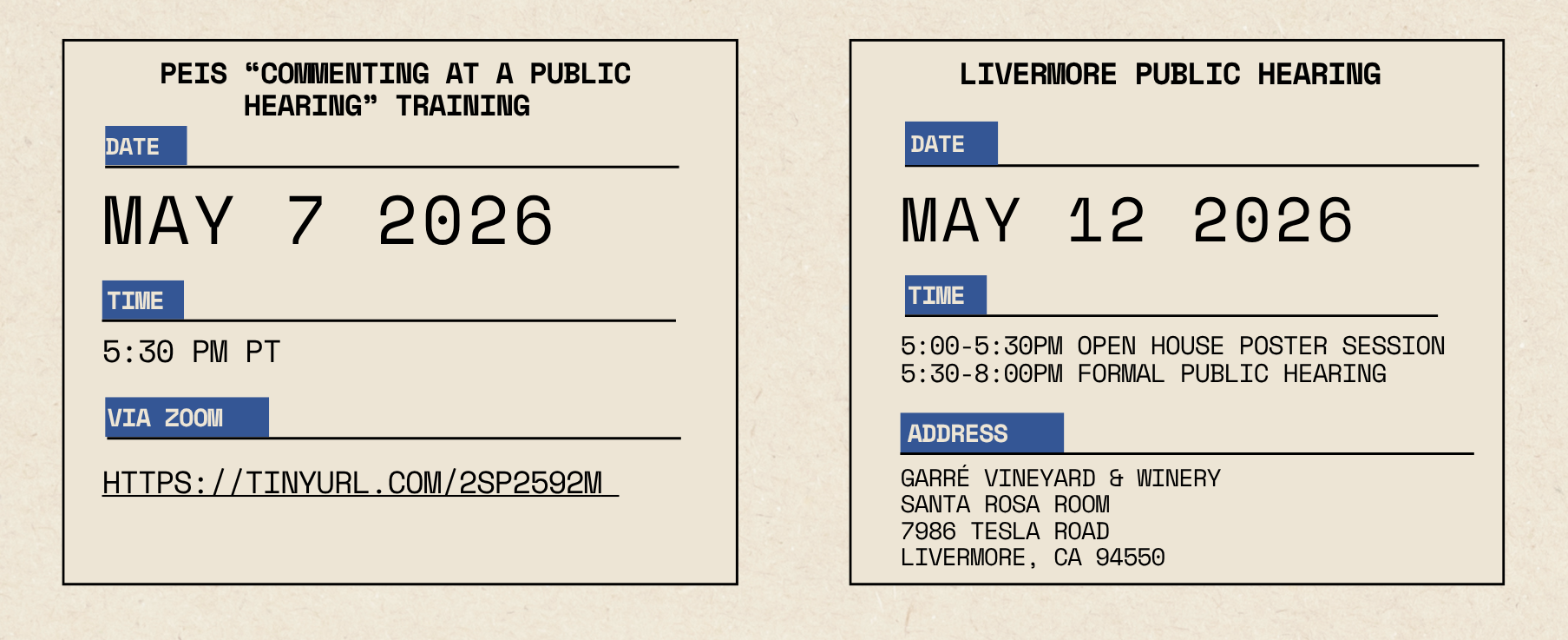
The Draft PEIS was released April 10 and the comment period is now open! There will be five public hearings across the country where community members will be able to give brief oral comments, with one of them being in Livermore as LLNL will be conducting plutonium pit support work. To prepare community members for this hearing, Tri-Valley CAREs will be holding a virtual oral comment training on May 7. Details of the comment training and hearing are below and on our website pitpeis.com
Tri-Valley CAREs will bring their concerns that were brought up on the tour to government officials in Washington DC next month and seek to continue to mobilize the community to voice their opposition to plutonium pit production!