
For more than three decades after the end of the Cold War, the US has claimed to only undertake modifications and life-extension programs (LEPs) on its existing nuclear weapons. While Tri-Valley CAREs and our colleagues have pointed out that many of these LEPs or “mods” are so extensive that they amount to entirely new nuclear weapons, the National Nuclear Security Administration (NNSA) has now acknowledged that it seeks to develop an entirely new nuclear bomb, the B94. This raises serious questions about America’s nuclear posture and the expanding ambitions of the nation’s nuclear weapons laboratories, specifically our local Lawrence Livermore National Laboratory.
The news of the B94, a designation given to it because it is an air-delivered nuclear gravity bomb, quietly emerged in a recently released Senate Appropriations Committee funding document for Fiscal Year 2027, which recommends an additional $77.108 million for the weapon. Yet the public has been given virtually no explanation of what the bomb will look like, what capabilities it will possess, why it is needed, how much its development and eventual production will cost or which national laboratory (Lawrence Livermore or Los Alamos) will serve as the lead lab on its development.
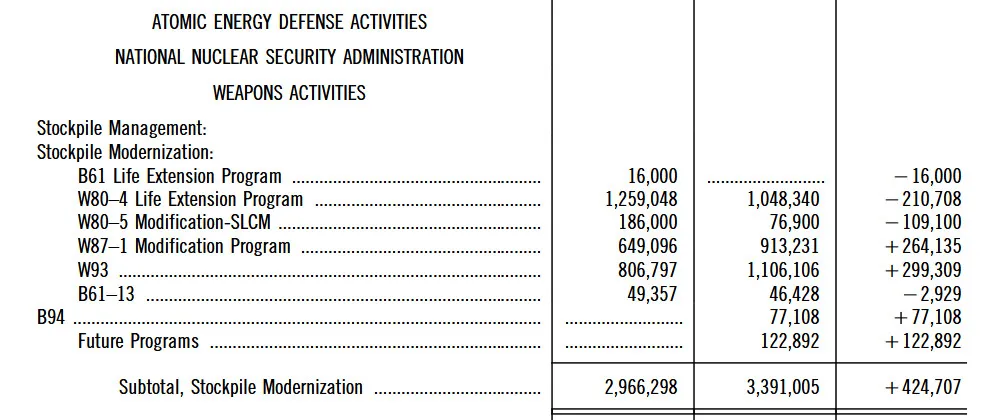
Although the precise identity of the B94 has not been officially confirmed, available information strongly suggests that it may be associated with the previous funding given to NNSA’s Nuclear Deterrent System-Air-delivered (NDS-A) program to develop a new nuclear weapon intended to provide the United States with additional capabilities to attack hardened and deeply buried underground targets.
The emergence of the B94 represents much more than another nuclear weapons modernization project. It may signal a fundamental shift in U.S. nuclear weapons policy: a return to developing entirely new nuclear weapons and expanding the potential military missions for which they might be used.
A New Nuclear Weapon, Not Just Another Modernization Program
Since the end of the Cold War, successive U.S. administrations have invested hundreds of billions of dollars in modernizing the nation’s nuclear arsenal. These efforts have included replacing aging delivery systems, refurbishing existing warheads, and extending the service lives of nuclear weapons through life-extension programs, and the costs have been staggering.
Developing a new bomb goes beyond maintaining and modernizing existing nuclear weapons. For decades, the United States maintained that it could preserve the safety, security, and reliability of its nuclear arsenal without developing entirely new nuclear weapons or conducting explosive nuclear tests. The Stockpile Stewardship Program was established to maintain the existing arsenal without resuming underground nuclear testing. Life-extension programs were generally presented as a means of sustaining existing weapons rather than developing new designs and expanding their military capabilities (though in many cases the weapons were thoroughly changed from their original designs and even given altered military capabilities).
The B94 appears to represent a significant departure from that approach.The last new designation for a U.S. nuclear gravity bomb was the B90, a weapon intended to serve as both a nuclear depth bomb and a weapon for attacking land targets. Its development was canceled in September 1991, as the Cold War ended and the United States began reducing its nuclear arsenal.
More than 35 years later, the emergence of the B94 suggests that the United States is moving toward developing a new nuclear gravity bomb with new capabilities and a potentially expanded military mission.
This represents a return to developing entirely new nuclear weapons in the post-Cold War era, raising fundamental questions about the direction of U.S. nuclear policy and the consequences for international nuclear stability.
What Is the B94 Intended to Do?
While the precise design and capabilities of the B94 remain undisclosed, reporting suggests that it may be the weapon associated with NNSA’s Nuclear Deterrent System-Air-delivered program.
NNSA has described the NDS-A as a system intended to provide the President with additional nuclear options for defeating “Hard and Deeply Buried Targets.” In other words, the United States is pursuing another nuclear weapon specifically intended to attack underground facilities that existing conventional weapons cannot reliably reach.
However, the US already possesses nuclear weapons capable of attacking hardened targets, including the B61-11 gravity bomb and the B83-1. The B61-11 was specifically configured to attack deeply buried targets, while the B83-1 has a maximum explosive yield measured in the megatons.
The B94 may be intended to replace, supplement or expand existing capabilities(like by hitting even deeper targets) although NNSA has not publicly clarified its plans. But this raises a fundamental question: Why does the United States need yet another nuclear weapon, particularly one intended to expand the range of targets that could be attacked with nuclear explosives?
The pursuit of increasingly specialized nuclear weapons risks creating a never-ending cycle in which new military requirements are used to justify new weapons, which in turn generate demands for additional capabilities.
There will always be another underground facility or military installation that planners claim requires a more capable weapon. Without a clear strategy for limiting nuclear weapons missions, this process has no obvious endpoint.
We Have Fought This Battle Before: The History of the Nuclear Bunker Buster
The B94 is not the first attempt by the United States to develop a nuclear weapon specifically designed to destroy deeply buried underground targets. More than two decades ago, the Bush Administration pursued a similar initiative called the Robust Nuclear Earth Penetrator (RNEP).
The RNEP, commonly known as the nuclear bunker buster, was intended to modify existing nuclear bombs to penetrate the earth before detonating, concentrating the explosive energy against deeply buried facilities. The program was promoted as a way to attack underground military installations and command centers that conventional weapons could not reliably destroy.
The Bush Administration requested $27.6 million for RNEP research in FY 2005 and projected nearly $485 million over five years for the effort.
Tri-Valley CAREs was a vocal opponent of the RNEP program. Working with our colleagues at the Alliance for Nuclear Accountability, a national coalition of nuclear disarmament and public-interest organizations, we challenged the program through research, public education, congressional advocacy, and direct engagement with lawmakers. We exposed the dangers of developing new nuclear weapons for specialized military missions and helped build the political opposition necessary to stop the program.
Our joint efforts were instrumental in persuading Congress to eliminate funding for the RNEP. The program was subsequently terminated by the Nuclear Weapons Council in January 2006. Tri-Valley CAREs considers this one of our significant victories in challenging the development of new nuclear weapons at Lawrence Livermore National Laboratory and throughout the U.S. nuclear weapons complex.
The proposed B94 raises many of the same concerns that animated our opposition to the RNEP. Once again, the US appears to be pursuing a nuclear weapon specifically intended to attack deeply buried targets, potentially expanding the circumstances in which nuclear weapons might be considered for military use.
The history of the RNEP campaign demonstrates that these programs are not inevitable. Public scrutiny, sustained advocacy, congressional oversight and the inevitable escalation in costs can stop the development of new nuclear weapons. Now, with the emergence of the B94, we recognize the familiar arguments being used to justify this development, and we know from experience that sustained public advocacy and congressional oversight can make a difference.
Which National Laboratory Will Develop the B94?
Another important unanswered question is which of the nation’s nuclear weapons laboratories will be responsible for leading the B94’s design and development. NNSA has not yet publicly identified the lead national laboratory for the program. Two possible candidates are Lawrence Livermore National Laboratory (LLNL), in Livermore, California, and Los Alamos National Laboratory (LANL), in New Mexico. Both are major nuclear weapons design laboratories with extensive experience developing and maintaining the nation’s nuclear arsenal.
LLNL already plays a central role in the nation’s nuclear weapons enterprise, and it is busy at work as the lead lab on the new W87-1 warhead that will pair with the new Sentinel Intercontinental Ballistic Missile. Likewise, LANL is very busy with new plutonium pit production for the W87-1. With both labs already dealing with rapid increases in program, adding in the B94 program raises important questions about the laboratories’ capacity, future mission, resources, worker safety, and responsibilities.
Whether LLNL or LANL is selected to lead the B94 program, the public deserves to know what work will be undertaken, what additional facilities and capabilities may be required, and what the anticipated costs and possible environmental consequences will be.
The absence of publicly available information about the lead laboratory is another example of how major decisions about the nation’s nuclear weapons future can move forward with remarkably little public discussion.
A Troubling Message to the Rest of the World
The development of the B94 also carries serious implications for international nuclear nonproliferation. The United States has long presented itself as a leader in preventing the spread of nuclear weapons. Under Article VI of the Nuclear Non-Proliferation Treaty (NPT), the United States and the other nuclear-armed treaty members have undertaken an obligation to pursue negotiations in good faith toward nuclear disarmament.
Yet developing entirely new nuclear weapons sends a contradictory message. By developing new weapons with expanded capabilities, the US undermines the credibility of its commitment to nuclear restraint and any purported commitment to the NPT.
Other nuclear-armed countries are watching. Russia and China, in particular, are also engaged in nuclear modernization programs. The development of new US nuclear weapons provides easy justification for their own investments in new warheads, delivery systems, and military capabilities, furthering the new nuclear arms race that is already underway.
There is another troubling dimension to the B94. A weapon specifically designed to destroy deeply buried targets could expand the circumstances in which US military planners consider nuclear weapons necessary. Rather than reducing reliance on nuclear weapons, the United States would be developing new capabilities that could make nuclear options appear more attractive for addressing particular military challenges. It’s harder to persuade other countries to stay away from nuclear weapons if the countries that already have them keep relying on them.
Another Justification for Expanding the Nuclear Weapons Complex?
The B94 also raises important questions about the future of the nation’s nuclear weapons production infrastructure. NNSA is pursuing an ambitious program to reestablish large-scale plutonium pit production. These pits are the primary nuclear explosive components at the center of nuclear warheads. NNSA wants to produce at least 80 pits annually (and possibly up to 205!) between LANL and the proposed production facility at the Savannah River Site (SRS) in South Carolina.
Currently, we await the Final Programmatic Environmental Impact Statement for new Plutonium Pit Production, that is being prepared in response to a lawsuit brought by Tri-Valley CAREs and our colleagues at Nuclear Watch New Mexico and SRS Watch. The United States already possesses thousands of plutonium pits, and significant questions remain about their longevity, the actual requirements of the existing nuclear stockpile, and the justification for producing so many additional pits.
The emergence of the B94 adds another important dimension to this debate. Will the B94 require newly manufactured plutonium pits, or can it use existing components and materials? Will its development generate additional production requirements? What assumptions about the future size and composition of the nuclear arsenal are driving NNSA’s plans? What is the proposed timeline for its development?
The Public Deserves Answers
Perhaps the most troubling aspect of the B94 announcement is how little information has been made available. Congressional budget documents recommend more than $77 million for the weapon, yet provide no meaningful explanation of its intended design, capabilities, strategic justification, or projected lifetime cost.
NNSA and the Department of Defense should explain:
- What specific military requirement justifies developing an entirely new nuclear bomb?
- What specific types of targets is the B94 intended to destroy that cannot be addressed through existing nuclear or conventional capabilities?
- Why is a new weapon necessary rather than modifying or extending the service life of existing weapons?
- What will the weapon’s explosive yield and intended delivery capabilities be?
- Is the B94 intended to replace or supplement the B61-11, the B83-1, or both?
- Which national laboratory will lead its development, and what roles will Lawrence Livermore and Los Alamos play?
- What is the projected total cost of development, production, deployment, and maintenance?
- Will the weapon require newly manufactured plutonium pits or other new nuclear weapons production capabilities?
- How does developing an entirely new nuclear weapon comport with US obligations and commitments under the Nuclear Non-Proliferation Treaty?
These questions go to the heart of the nation’s nuclear weapons policy and the direction in which the United States is taking its nuclear arsenal. These questions should be answered in the public sphere and to congress before additional funds are committed to this program.
Tri-Valley CAREs will be closely monitoring the B94 program and seeking answers from NNSA and Congress about its purpose, development, costs, and implications for the future of the U.S. nuclear arsenal. We will keep our members informed as more information comes to light and continue working to ensure that the development of new nuclear weapons does not proceed without public scrutiny and accountability.
Para leer esta información en español HAGA CLIC AQUÍ!